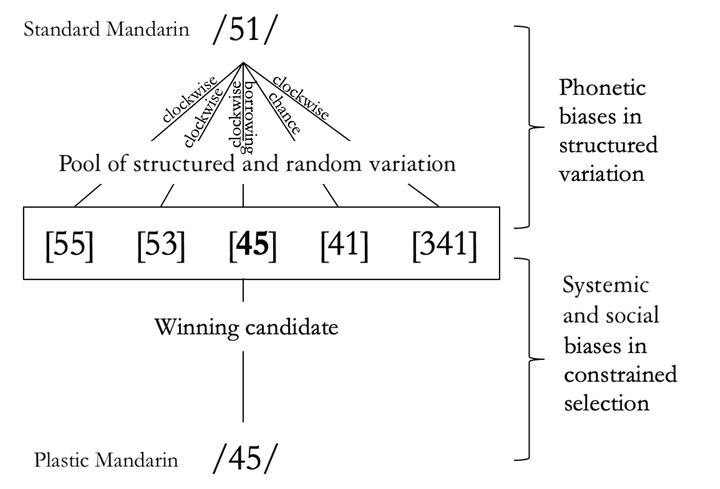
 Schematic illustration of the phonologisation of the high rising contour of Tone 4 in Plastic Mandarin. Variants [53], [55], [341], and [45] reflect the clockwise bias in tonal variation. [45] may also be a borrowed variant and [41] a phonetically similar random variant.
Abstract
Local differentiation and innovation in spoken Mandarin are now ubiquitous in metropolises in China, accelerated by the widespread promotion of the national lingua franca Standard Mandarin. This paper examines the lexical tones of Plastic Mandarin, a newly crystallised urban Mandarin dialect in Changsha, where the dominant regional variety has been Changsha Xiang. This paper establishes the lexical tone system for Plastic Mandarin using Growth Curve Analysis and explores its development by comparing its tones with those of Changsha produced by the same group of multilingual speakers, employing Generalised Additive Mixed Modelling. The findings show that, while Plastic Mandarin shares the same tone categories as Standard Mandarin, it features distinctive f0 patterns, some of which closely resemble their corresponding Changsha tones. These f0 patterns, imbued with regional identity, are likely motivated by phonetic variation, systemic constraints, social biases, and language contact. The case of Plastic Mandarin may exemplify contact-induced tonal contour changes in forming new Mandarin varieties.